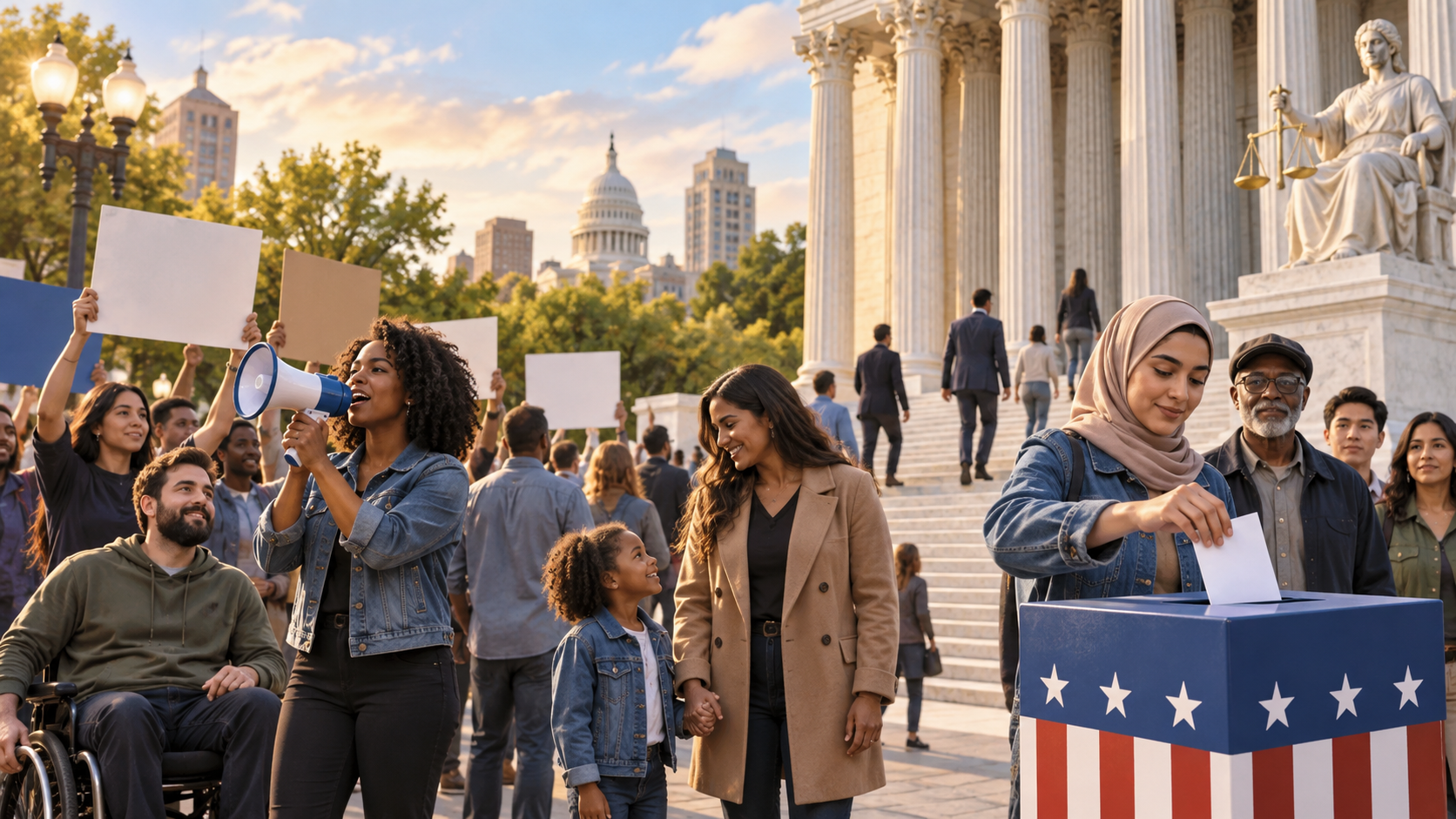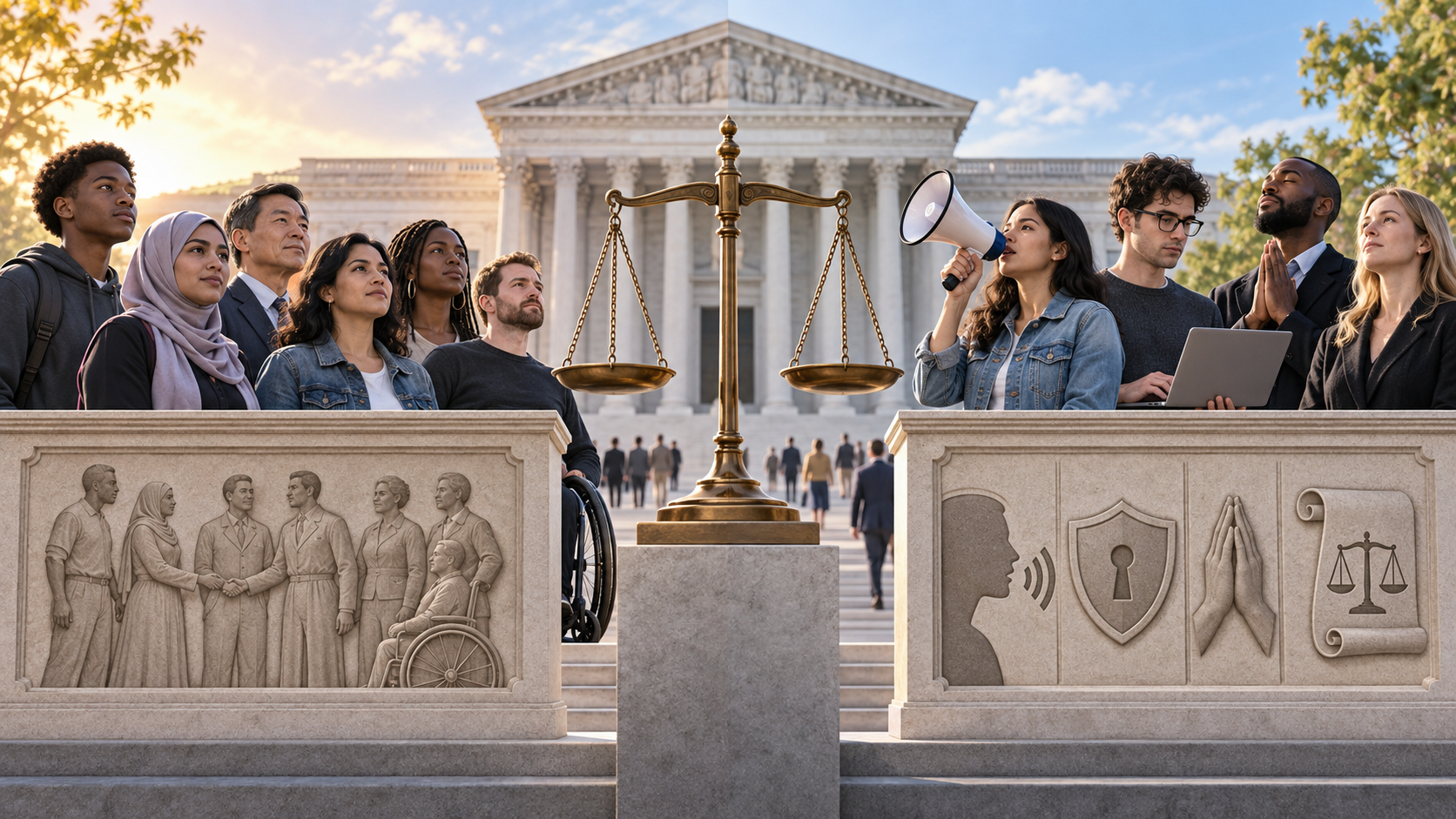
The same words can raise different legal issues
A resident criticizes the mayor at a city meeting, posts the same criticism on a privately operated social network, and repeats it during a shift at work. The message has not changed, but the legal setting has. A government restriction may trigger the First Amendment, a platform may apply its own moderation rules, and workplace consequences may depend on employment law and the job. Treating all three events as one free-speech dispute hides the distinctions that determine the result. The First Amendment protects a broad sphere of expression, including unpopular political ideas, but it does not create an unlimited entitlement to speak in every place or avoid every consequence. Understanding its reach starts with identifying who acted, what they did, and which legal relationship connects them to the speaker.
Government action is the constitutional starting point
The First Amendment limits government power over expression. Through constitutional doctrine, its protections apply to federal, state, and local government action. A city official, a public school, and a government agency therefore face constitutional obligations that an ordinary private book club does not face in the same way. The difficult cases arise when public and private roles overlap, or when a nominally private organization participates in conduct attributable to the government. Public visibility or popularity alone does not turn a private business into a government actor.
The Congressional Research Service’s overview of freedom of speech explains the central state-action distinction. That distinction is a starting point rather than an answer to every dispute. Other laws, contracts, or state constitutional provisions can protect expression in particular private settings. Conversely, finding government involvement does not automatically establish a violation. Courts still consider the kind of restriction, the setting, and the government’s asserted justification under the relevant legal standard.
Private consequences and legal protection can coexist
A newspaper generally chooses which letters to print, and a private discussion group generally chooses how to moderate its conversation. The First Amendment does not ordinarily force either to distribute every submitted viewpoint. A social platform’s removal of a post can therefore raise an important debate about fairness or company policy without necessarily establishing a constitutional violation by that company. The analysis changes if government coercion or another legally significant form of state involvement is involved, and it can be complicated by other statutes and ongoing litigation.
Employment requires similar care. A private employer’s response to an employee’s speech usually raises employment-law and contractual issues rather than a direct First Amendment claim. Some speech may receive separate protection, such as covered collective activity about working conditions or a qualifying whistleblower disclosure. Other expression may not. A public employer, meanwhile, operates under constitutional doctrines specific to government employment. The phrase free speech does not by itself identify which protection applies or whether an employer’s action was lawful.
Social consequences form another category. People may criticize an argument, stop subscribing to a publication, or decline to join a group. Their own expression and association can also receive protection. A constitutional commitment to open debate does not promise agreement, a receptive audience, or immunity from counterargument. That does not make every private consequence wise or fair. It means the legal analysis and the cultural discussion should remain precise enough to address the actual conduct rather than using one slogan to resolve every disagreement.
Political disagreement receives strong protection
Criticism of public officials, advocacy for policy change, and discussion of public affairs occupy a central place in American speech protection. Government generally cannot suppress an idea merely because officials dislike it or consider it offensive. Protection can extend beyond spoken words to expressive activities, depending on the conduct and context. Strong protection is especially important for minority views, because popular opinions are less likely to need protection from official suppression. Yet the constitutional analysis still asks what the government regulated and why: a law aimed at a message differs from a generally applicable rule addressing harmful conduct, and a speaker cannot automatically transform every action into protected expression by announcing a political motive. The same protection can benefit opposing groups at different times. A rule that lets officials silence a deeply unpopular campaign today could be used against a different movement after an election. Evaluating the power being claimed, rather than only the message currently targeted, helps explain why viewpoint neutrality matters. It asks whether the principle would remain acceptable when another official with different priorities controls the decision.
Location affects the rules for speaking
Streets and parks traditionally used for public expression receive different treatment from many government workplaces or restricted facilities. Courts use public-forum doctrine to distinguish these settings and assess the government’s power to manage them. A public building is not necessarily open for every kind of expression at every hour. A courthouse hearing, a city council comment period, and an outdoor sidewalk involve different functions. Before treating a restriction as censorship, identify the actual space, its purpose, and whether the government has opened it for the kind of expression involved.
In an appropriate public forum, government may impose qualifying content-neutral time, place, and manner restrictions that meet constitutional requirements. A rule governing amplified sound at night can serve a different purpose from excluding one side of a political debate. Permit systems and meeting procedures also need legal limits; officials cannot use neutral-sounding rules as cover for viewpoint discrimination. The practical distinction is between managing how a forum operates and selecting which opinions are welcome. Application matters as much as the language printed in the policy.
Narrow categories do not receive ordinary speech protection
Incitement has a demanding constitutional boundary. In Brandenburg v. Ohio, the Court distinguished advocacy of unlawful ideas from speech aimed at bringing about unlawful action imminently and likely to bring it about. Both the direction of the advocacy and the likelihood of the immediate conduct matter. An abstract defense of illegal conduct is therefore different from deliberately urging a prepared audience to commit a specific unlawful act at once, though a real case still requires the full context and applicable law. The government cannot establish the exception merely by describing a disturbing argument as dangerous. Other limited categories, including true threats, fraud, and defamation, have their own requirements rather than borrowing the incitement test wholesale.
Defamation involves more than criticism or an opinion someone strongly dislikes. It concerns legally actionable false factual statements, with standards that depend in part on the plaintiff and subject matter. Public officials and public figures face constitutional requirements that differ from those applicable in some private-person cases. Fraud similarly involves elements beyond the existence of inaccurate words. These distinctions prevent every harsh political statement or mistaken comment from becoming a simple exception to free-speech protection.
The boundaries also illustrate why context matters. Meaning can depend on the entire communication, the audience, the surrounding circumstances, and the speaker’s state of mind where legally relevant. A short clip or isolated sentence may omit facts essential to the analysis. Some conduct can violate a valid law even when words are involved, such as an unlawful transaction carried out through messages. The presence of speech does not end the inquiry, but the government’s description of the conduct does not eliminate constitutional scrutiny either.
Hateful ideas and unlawful discrimination are different legal categories
American constitutional law does not generally recognize a broad exception allowing government to ban speech merely because it expresses hateful or offensive views. That principle can protect disturbing expression while leaving room for laws addressing threats, violence, and other legally defined harms. The distinction is difficult emotionally because a message can be deeply damaging without falling outside constitutional protection. A careful discussion can acknowledge that harm while still identifying the legal standard that government must satisfy.
Discrimination and harassment law can address conduct in specific relationships, including employment and education, under defined requirements. Words may form part of that conduct, but a label alone is insufficient to decide whether a restriction is lawful. Context, severity, the relationship, and the governing statute can matter. Likewise, private institutions may adopt speech rules beyond what government could directly impose, subject to other applicable law and commitments. Separating these categories helps avoid the false assumption that protected expression must be harmless or that harmful expression is automatically unprotected.
Schools and public employment have specialized doctrines
Public school students retain constitutional speech interests, but school officials have authority to manage education under doctrines that differ across personal student expression, school-sponsored activities, and other settings. The Constitution Annotated discussion of schools and speech traces those distinctions. Public colleges, private schools, classrooms, athletic activities, and off-campus posts cannot all be collapsed into one rule. Age, sponsorship, disruption, and the institution’s role may affect the analysis, while state law or institutional promises can add other protections. Public employment adds another context-sensitive inquiry. Speech made as part of official job duties can receive different constitutional treatment from a public employee speaking as a citizen on a matter of public concern. Even protected interests may require examining the government employer’s operational needs. An employee should therefore identify the role in which the speech occurred and any applicable statutory protection before assuming that all public-sector expression follows the same rule.
Official social accounts require a closer look
An elected official’s personal page is not automatically a government forum, and calling a page personal does not settle the issue either. In Lindke v. Freed, the Supreme Court explained that the relevant state-action inquiry asks whether the official possessed actual authority to speak for the government on the matter and purported to exercise that authority in the relevant posts. The test requires attention to the official’s authority and how it was used, rather than relying only on the account’s title or a casual impression of its purpose.
That means a blocking dispute can require a detailed record. Preserve the post, the comment, the account description, the blocking event, and evidence about the official role. A page mixing family updates with official announcements may require post-specific analysis, and platform tools can complicate the effect of a block. The Supreme Court’s test does not mean that every citizen wins every such case. It identifies the constitutional threshold before courts assess whether the challenged action violated the applicable speech protections.
Compare a neutral meeting rule with selective enforcement
Imagine a city comment period with the same stated three-minute limit for every speaker. Enforcing that limit consistently addresses the meeting’s operation; allowing supportive speakers to exceed it while abruptly silencing equally situated critics raises a different concern. The written limit is identical in both examples, but its administration is not. Evidence would include the forum’s rules, actual speaking times, interruptions, and officials’ explanations, rather than only the critic’s disagreement with the mayor. The example does not decide every time-limit dispute: the setting, permitted subjects, and circumstances remain relevant. It shows why viewpoint analysis follows what officials did to comparable speakers, not whether a particular political message deserves approval from the reader or the person chairing the meeting.
How to assess a speech dispute without relying on slogans
Identify the actor and the consequence first. Was the speaker arrested, excluded from a government forum, disciplined at work, removed from a private service, or criticized by other people? Then identify the setting and the rule invoked. Those facts help distinguish a constitutional issue from a contract dispute, a statutory employment protection, or an argument over editorial judgment. Save the original material and any written explanation, because a paraphrase can omit details that change the legal assessment.
Next, distinguish the government’s treatment of a viewpoint from its management of conduct or a defined setting. Compare what the policy says with how it was applied to different speakers. A facially neutral time limit can still be administered selectively, while an unwelcome restriction can sometimes serve a lawful operational purpose. For a consequential dispute, qualified legal assistance can clarify the governing doctrine and deadlines. This article explains broad principles, not a guaranteed result for an unidentified school, employer, meeting, or court case.
The official sources here were reviewed on October 20, 2026. New decisions can refine particular rules, especially where public officials use private platforms. Identify the relevant facts and legal rules before deciding that a message is absolutely protected or wholly unprotected. A meeting’s time limit, a platform’s editorial choice, a workplace rule, and an allegation of incitement each require a different analysis. That is what protects unpopular expression while leaving room to address defined unlawful conduct and the legitimate operation of public institutions.