A street has limited space even when entry is unpriced
When another car joins a crowded street, its driver experiences a slower trip and can add delay for everyone behind it. Congestion pricing tries to make that shared cost part of the decision to drive at a particular place or time. The result is a visible charge where road access previously may have felt free, creating a debate about who should pay, who can change their trip, and what happens to the money. Supporters point to more reliable travel and better alternatives; critics raise affordability, access, diversion, and trust in government spending. Both sets of concerns require details rather than a slogan. A downtown entry charge differs from a priced express lane, and a program with good transit alternatives differs from one serving people with few practical choices. Evaluating the policy means following travelers through the entire network and separating observed traffic changes from claims about the causes and distribution of those changes.
Pricing changes demand rather than creating unlimited road space
Congestion pricing charges for using scarce road capacity under specified conditions. A price can vary by scheduled period or adjust more dynamically, depending on the program. Drivers may pay and continue, travel at another time, combine trips, share a ride, choose another mode, reroute, or decide not to make a discretionary trip. The intended mechanism is to reduce pressure on the constrained network enough to improve its operation. FHWA’s corridor-management and pricing primer explains that pricing works within a wider transportation system rather than as an isolated tolling device. It does not follow that every charged corridor will achieve the same result or that road space becomes unconstrained after a fee is introduced.
Different charging designs distribute the burden differently
A cordon charge generally applies when a vehicle crosses a defined boundary, while an area scheme can use a different rule for travel within the charged area. A priced lane offers a charged option along a corridor, sometimes alongside unpriced lanes, with occupancy or vehicle rules specific to the facility. A bridge toll can fund an asset without being designed primarily to manage congestion. These arrangements can overlap, but their charging triggers and alternatives differ. Identify the actual rule before assuming that a payment applies to every mile or every movement.
Rate schedules can distinguish vehicle classes, times, payment methods, crossing credits, and frequency limits. Delivery trucks may face a different amount from passenger cars; taxis and for-hire vehicles can have a separate collection arrangement. An account problem can also affect the amount billed. A driver planning a trip needs the current official calculator or schedule, not an old headline announcing a base price. The final cost depends on the vehicle and route as well as whether an exemption or discount has been approved.
The boundary is a policy choice with consequences. A narrow zone may target the most constrained streets but shift parking or traffic toward its edge. A wider zone can capture more trips while charging people whose travel has different alternatives. Excluding a highway can preserve through travel, yet drivers may still trigger a charge by leaving it for local streets. Maps must show the actual connections, not simply shade a district. Clear rules reduce accidental charges and make the public debate about access more concrete.
New York provides a current example with specific eligibility rules
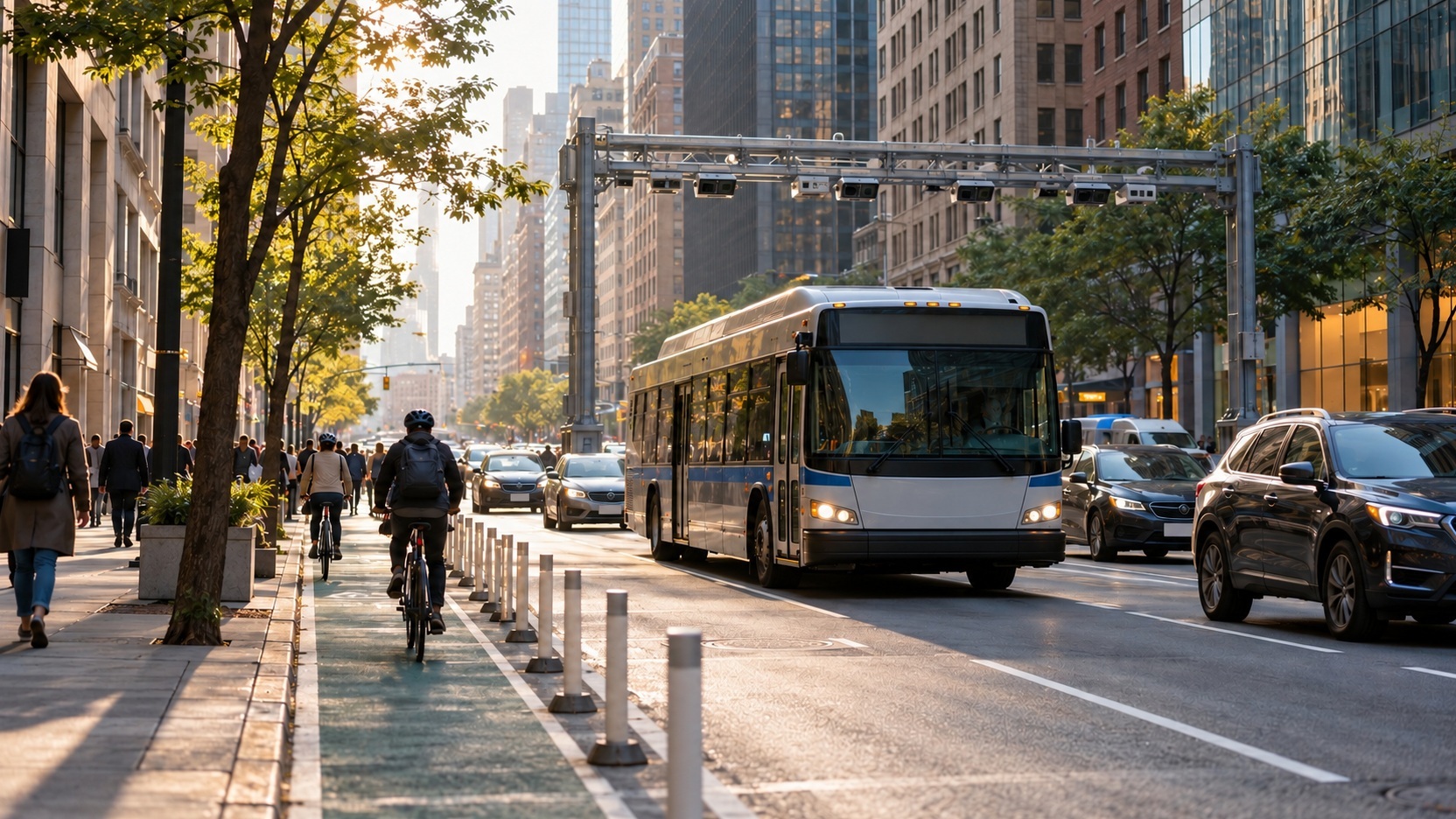
New York supplies an observed result as well as a charging design. In its January 5, 2026 anniversary account, the state reported 27 million fewer vehicle entries during the first year, an 11 percent reduction. It also reported faster crossings into the zone. These are the program operator and state government’s results, not an independent experiment proving that every change came from tolling. They nevertheless answer an important practical point: the operating program recorded substantially less entering traffic, rather than merely promising a future reduction.
The MTA’s discount and exemption page describes a low-income discount that begins after the first ten monthly trips for enrolled eligible vehicle owners and applies to later peak-period trips. It also describes disability-related exemptions with defined eligibility, not an automatic exemption for everyone who finds transit inconvenient. Current plans require application and, where applicable, recertification. These details illustrate why equity measures should be evaluated as an administrative process: eligibility on paper helps only if an affected person can understand, obtain, and retain the benefit. The charged area covers local streets south of and including 60 Street, with specified excluded highways. Entry counts should be read alongside speeds, diversion, and transit use because fewer crossings alone do not describe every traveler’s experience.
The people paying the toll and the people benefiting can overlap
A driver who pays may gain a more reliable trip, which can matter for work, appointments, or delivery schedules. The value depends on the time saved, how dependable the improvement is, and the traveler’s circumstances. A higher-income person may find the fee easier to absorb without being the only person who values reliability. A lower-income worker can have an inflexible start time and substantial consequences for being late. Analysis should examine both financial cost and practical benefit rather than categorizing every payer automatically as a winner or loser.
Bus riders can benefit when buses share streets that become less congested, even though those riders do not pay the same driving charge. Pedestrians and cyclists may experience changes in street activity, safety, or environmental conditions. Businesses can gain from more predictable deliveries while facing charges or adjustments to customer access. None of those effects should be presumed identical across locations. Curb use, loading behavior, enforcement, service schedules, and street design influence whether a reduction in vehicle entry translates into a useful improvement for other users.
The distribution also depends on who bears business costs. A delivery company can absorb a charge, change routes or schedules, add a surcharge, or spread costs across its customers. A household’s exposure may therefore include some indirect cost even if it never drives into the zone. That does not establish that every retail price rises by the toll amount. The appropriate analysis follows actual changes in operations and pricing rather than assuming either complete pass-through or no effect beyond the vehicle owner.
Revenue can produce additional benefits if it supports effective transportation improvements. Those benefits arrive on a different schedule from an immediate toll payment and depend on project delivery and service quality. A rider promised future accessibility or reliability needs to see funded projects, milestones, and performance. Counting a projected capital program as though every improvement were already delivered exaggerates the present benefit. The fiscal and transportation accounts should show what was collected, what collection cost, what was committed, and what users actually received.
Fairness depends on realistic alternatives and workable relief
An average comparison between drivers and transit riders can hide people with unusual but important constraints: disability, overnight shifts, caregiving, tools that must travel with a worker, or origins poorly served by transit. Equity analysis should examine those cases alongside the much larger population benefiting from less traffic or funded alternatives. FHWA’s income-equity primer explains why program design and use of revenue matter. Targeted relief can address hardship, but broad exemptions can weaken the demand-management effect and shift costs to remaining payers. The policy task is to define a justified benefit, make it accessible, and assess who still falls through the rules rather than assuming one general discount resolves every access problem.
Diversion must be measured beyond the charged boundary
Some drivers may avoid a charge by choosing another route, parking near the boundary, or shifting the time of travel. A program can therefore improve conditions inside a zone while creating pressure on other streets. Monitoring should include nearby neighborhoods, alternative crossings, parking, transit crowding, and freight routes. The important distinction is between trips eliminated or shifted to another mode and trips merely moved elsewhere. Network-wide results give a fuller account than a single count of entries at tolling points.
Mitigation should follow the observed problem. Changes to curb management, transit service, traffic signals, loading arrangements, or street protection may address specific effects. A general commitment to monitor is weaker than an agreement defining indicators, reporting intervals, responsible agencies, and a response when thresholds are crossed. Nearby residents deserve access to the evidence and a way to report conditions that a regional average misses. At the same time, a localized change should be checked against longer-term patterns before it is attributed entirely to the new charge.
Traffic improvements require more than one favorable number
Vehicle entries measure crossings into an area, not every vehicle-mile traveled or every person’s travel time. Speed can improve on one corridor and remain constrained at another intersection. Reliability concerns variation and predictability, while average travel time can hide exceptionally bad days. A useful dashboard reports these measures separately and explains where its sensors or samples operate. It should also distinguish passenger movement from vehicle movement, since a street carrying fewer cars can still move more people if buses operate effectively.
Before-and-after comparisons need context. Weather, holidays, construction, remote-work patterns, transit disruptions, economic activity, and other policies can change traffic. Comparable periods and suitable reference locations can improve the analysis, but no comparison is automatically perfect. A decline after the toll began is an observation; the size of the toll’s causal effect requires a stronger evaluation. Program operators’ data are useful, yet independent examination and transparent methods help the public assess claims without relying only on institutional promotion.
Environmental outcomes require their own evidence. Fewer entries do not mechanically establish a particular reduction in emissions or a uniform change in neighborhood exposure. Vehicle mix, travel distance, speeds, idling, rerouting, and background conditions can affect the result. Air-quality measurements need suitable comparison and interpretation. Health benefits may follow meaningful exposure reductions, but a short monitoring period should not be turned into a precise long-term medical claim. Explain what was measured directly and what was estimated through a model.
Business outcomes also deserve careful comparison. Foot traffic, sales, vacancy, delivery performance, and customer experiences describe different dimensions, and broader economic changes can affect them. A few interviews may reveal issues worth investigating without establishing the average effect. Strong evaluation follows comparable businesses and areas over time and identifies variation across sectors. The same standard should apply to claims of commercial revival and claims of widespread devastation. A transportation policy can produce mixed effects that require adjustment rather than one dramatic verdict.
Collection and governance affect legitimacy
A tolling system needs accurate vehicle matching, understandable bills, accessible disputes, proportionate enforcement, and clear protections for collected information. Drivers should be able to correct an error without navigating an opaque process that costs more than the disputed amount. Policymakers must identify who operates the system, who can access records, how long data are retained, and how oversight works. Revenue promises also need enforceable accounting and public reporting. A technically effective price can lose support if billing is unreliable or spending commitments remain vague, making administrative competence part of the transportation policy rather than a minor detail after the political decision.
Judge the program against its stated transportation goals
For a driver deciding whether to enter a charged zone, start with the route and vehicle, check the current toll and any approved relief, and compare a realistic alternative. Suppose a hypothetical trip costs $9 in tolls and saves twenty minutes. That exchanges $27 per hour of time saved before considering parking, fuel, or the value of reliability. It may suit a time-sensitive delivery and remain unaffordable for another traveler. Neither decision settles whether the regional policy is worthwhile.
For the region, compare the network result with the burden imposed. New York’s reported entry reduction is encouraging evidence about traffic volume; the separate questions are how travel times changed, whether adjacent streets absorbed traffic, and whether new transit investments delivered useful service. Report results for constrained users as well as averages. A successful design can still need targeted relief or changes at a troublesome boundary.
The practical test is whether the charge improves movement enough to justify its costs and whether promised alternatives arrive. Keep the original baseline, publish comparable periods, and identify the response to a documented problem. This turns a dispute over a visible fee into an assessment of actual trips, service, and access.