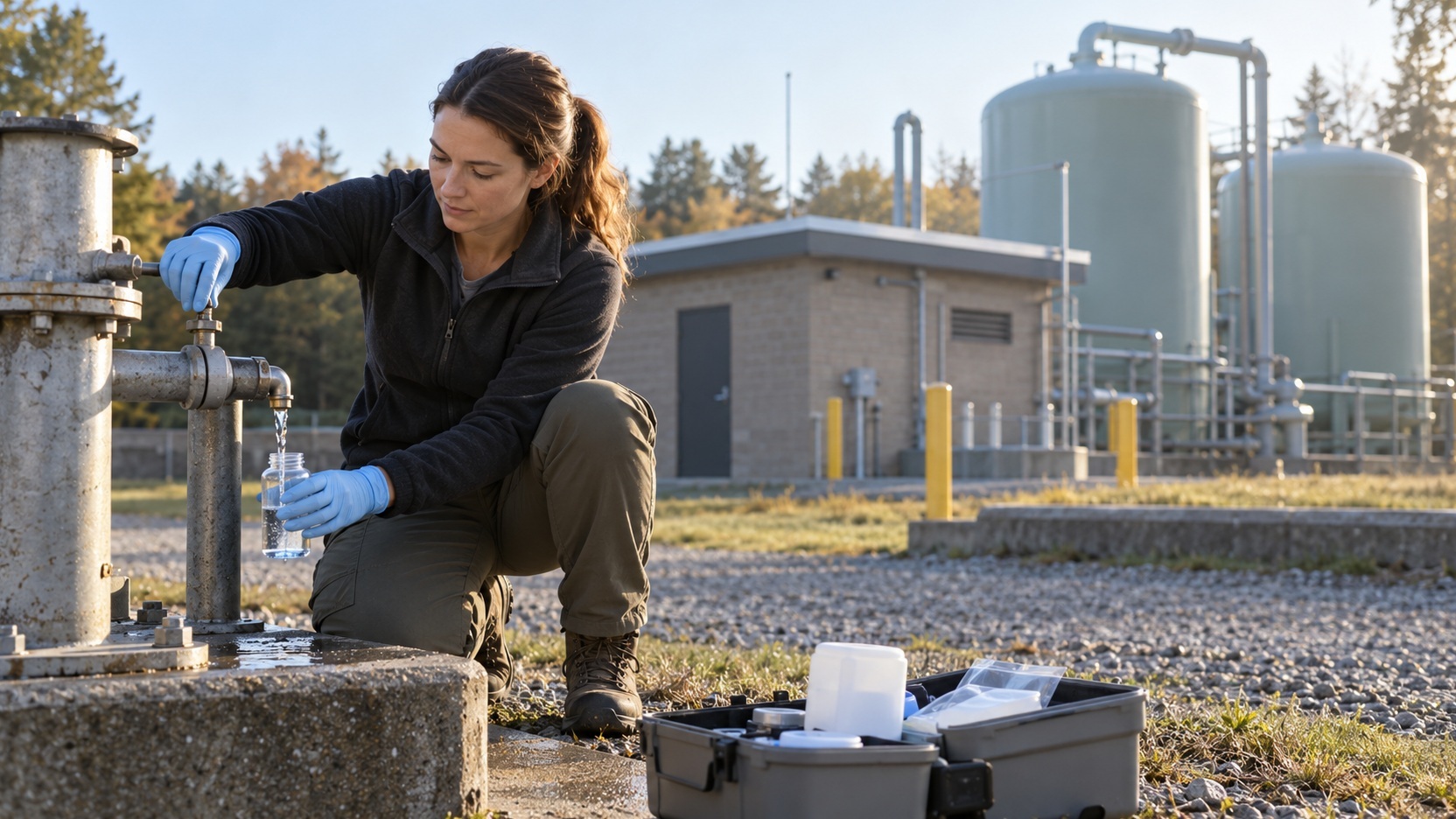
A tiny measurement can drive a major public decision
A water report lists a concentration in parts per trillion, and a community suddenly faces a decision involving treatment vessels, engineering contracts, household filters, and years of financing. PFAS contamination connects unusually small measurements with very large responsibilities. The chemicals grouped under the PFAS label are not identical, and neither are the rules governing them. Residents need to distinguish a laboratory detection from a violation, a health concern from a prediction about an individual person, and a proposed federal change from an effective legal requirement. Those distinctions are especially important during the current rulemaking process. As of October 20, 2026, EPA’s official pages describe proposed changes to parts of the federal drinking-water framework, including a potential compliance extension for two prominent PFAS. A community’s practical response should therefore follow the actual rules and local results, while continuing to address exposure and infrastructure needs rather than waiting for a headline to settle every issue.
PFAS is a family name rather than one contaminant
Per- and polyfluoroalkyl substances are a large group of manufactured chemicals used in many applications. The common nickname forever chemicals points to the persistence of many members of the group, but it can obscure differences in chemical behavior, exposure, and available evidence. PFOA and PFOS are well-known examples, not synonyms for the entire family. A test that measures a particular set of PFAS does not measure every possible member. Reading the actual analyte names is therefore essential before comparing results or deciding what treatment is appropriate.
Drinking water can be one exposure pathway, particularly where a supply has been affected by industrial releases or certain firefighting uses. Other pathways can also contribute, and their importance varies by person and location. A community investigation should identify the affected source and plausible contamination history without assuming that every household shares the same exposure. Maps and broad screening programs can guide attention, but a result tied to the water system or well serving an address provides a more direct basis for decisions about that supply.
ATSDR identifies associations between exposure to specific PFAS and outcomes including higher cholesterol and lower antibody response to some vaccines. Its health-effects overview names the substances for which evidence supports each association, rather than treating every PFAS as identical. Those population findings do not predict illness from a household water result. Dose, duration, the measured chemical, existing health conditions, and other exposures can affect the situation. Residents can use a credible exposure history to discuss appropriate care with a clinician while reducing an identified ongoing source. A blood or water number alone is neither an individual diagnosis nor a reason to dismiss a community’s concern.
Separate the existing rule from the proposed changes
EPA finalized a national drinking-water rule in 2024 that established enforceable limits for specified PFAS, including individual limits of four parts per trillion for PFOA and PFOS. In May 2026, the agency announced two proposed rules: one would preserve those two limits while creating an option for eligible systems to request additional compliance time to 2031, and another would rescind provisions covering PFHxS, PFNA, HFPO-DA and the specified mixture hazard index. EPA’s extension proposal and rescission proposal should be read separately. As described by those official pages on October 20, 2026, these are proposals, not an already universal 2031 deadline or a completed repeal. Check the final rule, effective dates, and state requirements before relying on any changed obligation.
A detection needs context before it becomes a conclusion
A laboratory report should identify the sampled location, collection date, analytical method, substances measured, units, and reporting limits. A non-detect generally means the substance was not measured at or above the method’s relevant reporting threshold, not proof that its concentration is exactly zero. A detected value likewise needs comparison with the standard or guidance applicable to that substance and water supply. Results from different methods or sampling periods may not be directly comparable. Keep the original report rather than relying on a shortened description shared online.
Regulatory compliance can depend on specified monitoring and averaging procedures, not simply one household’s isolated measurement. That does not make a household result unimportant; it changes what the result can establish. Ask the water system and regulator how the finding relates to required monitoring, whether confirmation is needed, and what action is planned. Where a result is near a relevant threshold, uncertainty and future sampling deserve explanation. The public should be able to see both the measured evidence and the reasoning connecting it to a response.
Public systems and private wells face different routes
Federal public-water-system regulations create obligations for covered suppliers, but an individual private well generally falls outside that framework. A well owner should not assume that a utility’s monitoring program has tested the household’s source. Contact the state or local health authority about nearby contamination concerns, appropriate laboratory testing, and any assistance available. Some local investigations include private wells around a known contamination site, but participation and coverage must be confirmed. The relevant question is whether this particular well has credible evidence of PFAS contamination.
For customers on a public supply, request the system’s PFAS results and ask whether the report describes raw water, finished water, or another sampling point. A utility may investigate alternative sources, blending, treatment, or operational changes depending on conditions and regulatory requirements. Residents should also ask how developments will be communicated, especially to renters who do not receive the bill directly. A well-run communication plan explains what is known, what remains uncertain, what users should do now, and when additional information is expected.
State standards can differ from the federal baseline, and a proposed federal change does not automatically erase an independent state requirement. A system may also have commitments associated with an enforcement order, funding agreement, or local response plan. The governing obligations should be identified in writing before a community postpones or redesigns a project. Officials can explain which requirements are currently binding and which potential future changes are being considered. That separation keeps the response connected to law and evidence instead of shifting political descriptions.
Treatment removes contamination from water but leaves management duties
Utilities can use technologies such as granular activated carbon, ion exchange, or high-pressure membranes under appropriate conditions. Performance depends on the PFAS present, source-water characteristics, flow, system design, and operation. EPA’s treatment research overview describes several approaches. No technology should be chosen solely because it worked at another location with a different water chemistry. Pilot testing and engineering analysis can help establish expected performance and the frequency of media replacement or other maintenance before a system commits to long-term costs.
Removing PFAS from drinking water also creates residual materials or concentrated waste streams that must be managed appropriately. A project’s budget should include operation, monitoring, energy, replacement media, and residual handling alongside construction. Source control can help reduce the future load, but it may not eliminate an existing plume or immediately restore a contaminated supply. Good planning therefore considers both the treatment needed now and the upstream actions that could reduce future dependence on that treatment. A new vessel alone does not finish the environmental problem.
Household filtration requires a verified, maintained match
A home device may reduce PFAS exposure, but the claim must be tied to the exact model, contaminants, and certification conditions. EPA’s home-filter guidance cautions that certification does not automatically demonstrate removal down to every new regulatory level. Compare the device’s verified performance with the actual concern, follow replacement instructions, and consider confirmatory testing where appropriate. Boiling does not remove PFAS and should not be used as a substitute for an effective reduction method. A household should also understand installation costs, cartridge availability, maintenance, and which outlets are treated. Filters can provide a useful interim or ongoing measure, but distributing equipment without support for upkeep can leave residents with an apparent protection that weakens over time.
The financing debate is about responsibility as well as engineering
Treatment costs can be especially difficult for a small system because engineering and equipment expenses are spread across relatively few accounts. A proposed rate increase should identify the project scope, funding already secured, expected operating costs, and alternatives considered. Grants, subsidized loans, litigation recoveries, or other assistance can affect the amount customers ultimately pay, but their availability and permitted uses vary. Residents deserve an explanation of the difference between an announced funding opportunity and money that has actually been awarded and committed to the local project.
There is also a fairness issue: water customers may be paying to address contamination they did not create. Efforts to recover costs from responsible parties can be relevant, but the timing and uncertainty of those efforts should not be hidden. A utility may need to act before a legal dispute is resolved. Policymakers must decide how immediate protection will be financed and how later recoveries will be treated. Clear accounting makes it possible to assess whether customers receive the benefit of external funding rather than paying twice for the same expense.
Affordability planning should consider tenants, low-income customers, and private-well households alongside the utility’s average account. A nominally modest monthly charge can be difficult for a household already struggling with essential bills. Assistance, phased financing, or coordinated regional solutions may help, but each option carries eligibility and governance choices. The public discussion should include the ongoing cost of operation, not only a ribbon-cutting construction price. A system that cannot maintain treatment reliably has not achieved the intended durable protection.
Medical testing answers a different set of questions
Water testing characterizes a supply; blood testing characterizes measured PFAS in a person’s blood. The results cannot be substituted for one another. ATSDR’s blood-testing guidance explains that a blood test cannot predict an individual’s future health problems or identify a treatment that removes the exposure’s consequences. A clinician can discuss the potential benefits and limitations in light of a person’s history. Bringing a credible exposure record can make that discussion more useful than asking for an unexplained screening panel.
Public-health communication should leave room for both action and uncertainty. Residents can reduce a known exposure without assuming illness is inevitable, and officials can acknowledge scientific limits without dismissing a community’s concern. Maintain ordinary preventive care and discuss specific symptoms or medical concerns with a qualified professional. Programs offering testing should explain what participants will receive, how privacy will be protected, and what follow-up assistance is available. Collecting numbers without a plan for interpretation can create confusion rather than meaningful support.
What a treatment timetable should show residents
Imagine a fictional utility that detects a regulated PFAS and is evaluating carbon treatment. Its first public timetable should distinguish confirmed sampling, engineering design, pilot operation, funding approval, construction, and finished-water testing. Saying only that treatment is planned leaves residents unable to tell whether any of those steps has occurred. A useful update explains the near-term exposure advice and the current legal requirements while design proceeds. If a pending regulatory change could alter the deadline, the utility should identify that contingency without treating it as completed law.
Pilot results should answer a practical operating problem: how long the treatment works with this source water before media replacement is needed. A laboratory demonstration and a long-running plant face different conditions. The budget should include monitoring, replacement material, energy, trained operators, and handling the PFAS-bearing residuals. If grant money pays for construction but the community must finance those continuing costs, residents need to see that distinction before the project is described as fully funded. An installed vessel is an intermediate milestone, not proof of sustainable exposure reduction.
The final test is repeated evidence from the water people receive. Published finished-water results, an operating schedule, and an explanation of any breakthrough or equipment interruption let residents see whether the chosen treatment continues to work. A private-well household needs an equivalent maintenance and retesting plan appropriate to its own equipment, without assuming the utility’s measurements describe its well. This makes the continuing responsibility concrete: confirm performance after installation, replace treatment before it stops delivering its intended benefit, and tell affected people promptly when the operating plan changes.