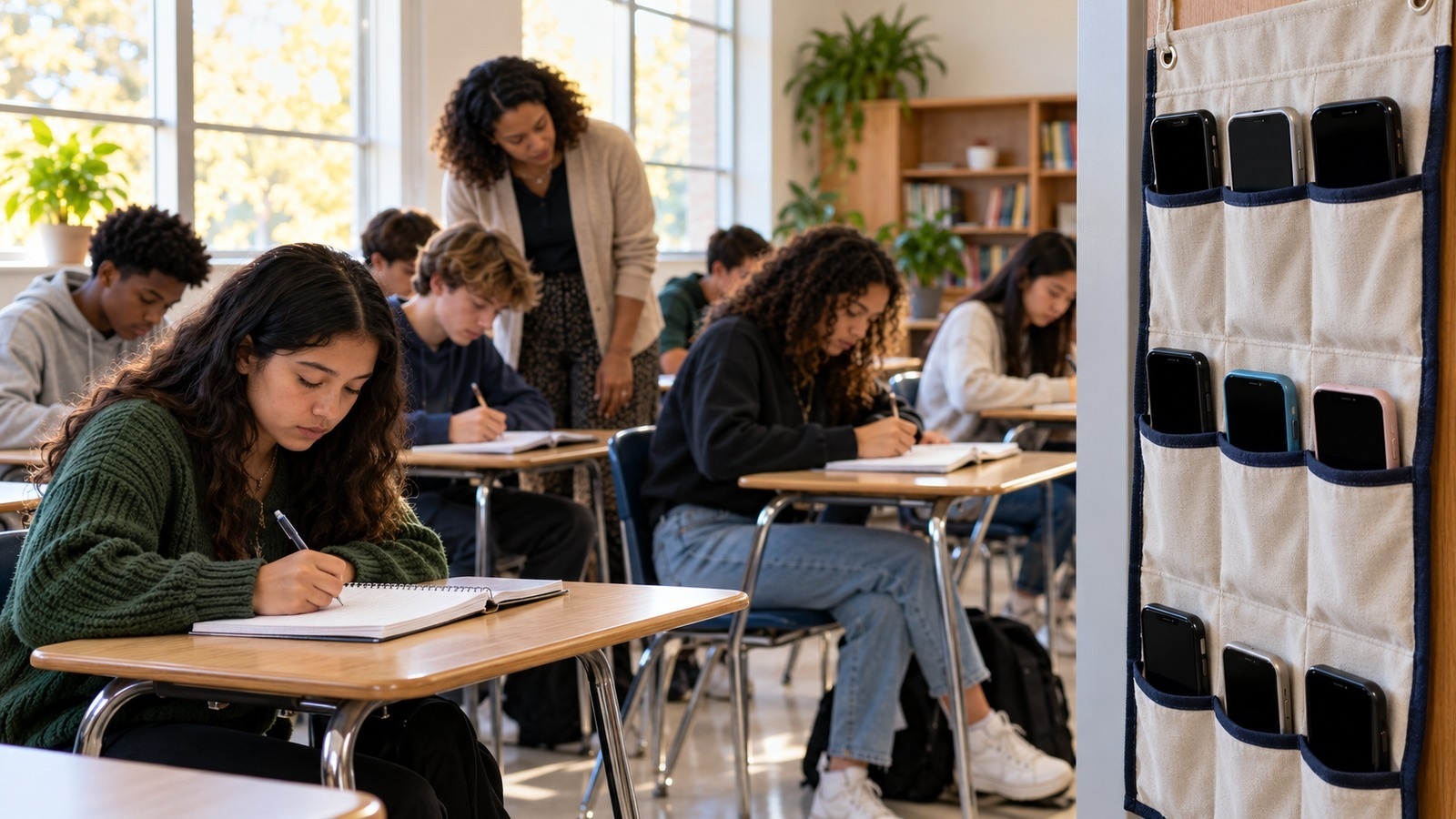
A quieter classroom is a starting point
The phone disappears into a pouch, the lesson begins, and a classroom suddenly has fewer opportunities for interruption. That visible change explains much of the appeal of school cell phone bans. It also leaves the harder policy issues unresolved: whether attention improves enough to change learning, whether children feel better, and whether enforcement creates problems of its own. A restriction can be sensible without delivering every benefit its supporters predict. For parents, students, and school boards, the useful task is to examine the actual rule, the practical support behind it, and the outcomes that follow. Rules covering an entire school day differ from instructions to put a device away during teaching. Medical accommodations, emergency communication, and fair discipline are central design decisions. Evaluating those details gives families a better guide than treating every phone ban as the same experiment.
Define the restriction before judging its results
A school can prohibit visible phones during lessons while allowing them at lunch, or require devices to remain inaccessible from arrival until dismissal. It can permit a switched-off phone in a backpack, collect devices centrally, or use individual locking pouches. These approaches produce different levels of access and different workloads. A study of one arrangement cannot establish the effects of all the others, even when each school describes its approach with the same word: ban.
The policy also needs to identify which devices it covers. A student may receive messages through a watch, listen through wireless earbuds, or open social media on a school laptop. Expanding a rule to every connected tool can complicate instruction, while ignoring substitutes can undermine it. Clear boundaries allow teachers to explain the purpose of a restriction and help students distinguish an authorized learning activity from recreational use. Age also changes the design problem. An elementary school where few children carry a phone may need a simpler procedure than a large high school where students arrive independently and have jobs after class. Districtwide consistency has advantages, but it should not conceal differences in how students travel, communicate, and use technology for legitimate tasks. Schools should explain why the selected scope fits their population instead of relying on a policy borrowed from a very different setting.
Why attention is the clearest immediate target
A device creates a competing destination for a student’s attention even when a teacher has prepared an engaging lesson. Messages invite a response, feeds offer novelty, and photographing classroom moments can pull classmates into the interruption. A restriction reduces some of those invitations and the need for teachers to negotiate each instance. The benefit is especially plausible when a consistent routine replaces repeated arguments about whether a particular glance was school related.
Attention is nevertheless a pathway to learning rather than a substitute for instruction. Extra minutes help only if students can use them productively, understand the material, and receive support when they fall behind. A school with fewer visible phones may still have weak attendance, unmet learning needs, or an understaffed classroom. Phone policy can improve one condition for teaching without solving those broader constraints.
A useful implementation review asks how often teachers stop lessons to address devices and whether students report being able to concentrate. Those measures can change sooner than annual test scores and can reveal where a rule is being followed. They also require care: a teacher who supports the policy may perceive an improvement before independent observation confirms it. Combining several measures gives a more credible picture than relying on a single enthusiastic account. It is helpful to include students who previously struggled to stay engaged, rather than assume an average improvement describes everyone. Some may welcome relief from constant notifications, while others may find new ways to disengage. Interviews can identify those experiences without replacing systematic measurement. The purpose is to understand whether the reclaimed attention reaches the children the policy was supposed to help, and what additional teaching or support would make that time more useful.
What the research can support
The Florida evidence concerns a particular all-day policy and a two-year adjustment. Figlio and Ozek’s October 2025 working paper studied a large urban district using student records and differences in pre-ban phone activity across schools. The period included the 2022–2023 school year before the ban and two years afterward. It found improved test performance in the second year and fewer unexcused absences, with stronger effects in middle and high schools. But suspensions increased initially, especially among Black students, before disciplinary effects began fading after the first year. NBER’s research summary reports a 25 percent increase in suspensions during the first month relative to the same month a year earlier. This is a quasi-experimental working paper, not a randomized national trial, and the district’s all-day backpack-storage rule differs from a lesson-only restriction or a pouch purchase. The findings support the possibility of academic benefits while making enforcement costs part of the evidence, rather than treating fewer visible devices as the sole measure of success.
Well-being requires a wider lens than screen access
Reducing access at school could ease the pressure to respond immediately, limit filming without consent, or give students more chances to speak face to face. Those are plausible mechanisms rather than proof that a ban treats anxiety or depression. A student can still encounter harmful content after dismissal, and a school restriction need not reduce total daily use. Emotional health also reflects relationships, sleep, safety, family circumstances, and access to care.
Mental-health evidence answers a separate issue. Henry Saffer’s May 2026 working paper used National Survey of Children’s Health data from 2016–2024 and synthetic difference-in-differences models. It found no clear evidence that bans reduced screen time or improved the psychological-well-being measures studied. The post-policy record was short: one state supplied two post-ban periods and two states supplied one each. That limits power and longer-term inference; it does not prove that no student benefits. It also prevents turning Florida’s achievement findings into a mental-health claim. A school can improve a learning condition without demonstrating treatment of anxiety, depression, or other clinical outcomes.
Exceptions should function without public disclosure
Some students use a phone as part of medical monitoring, communication access, or an individualized disability accommodation. A workable rule needs a documented way to address those needs with the appropriate school team. It should not require a child to explain a diagnosis in front of classmates whenever a device is used. Staff training matters because a formally approved exception offers little protection when substitute teachers or hallway supervisors do not know how to recognize it.
Other exceptions involve caregiving responsibilities, transportation changes, or unusual family circumstances. Schools need not handle every request identically, but they should explain who decides, what information is necessary, and how families can seek reconsideration. Otherwise informal favors can become the real policy. Students with confident advocates may gain access while others with comparable circumstances do not know an exception exists.
The physical storage method also deserves an accessibility review. A collection point may create problems for a student who cannot reach it, while a pouch can interfere with quick access to approved monitoring. Planning these details before launch avoids treating predictable needs as misconduct. The policy should provide an alternative that preserves the educational goal while allowing the student’s actual support plan to work.
Discipline can either support or consume the lesson
Enforcement works best when students understand the sequence of responses and teachers can apply it consistently. A reminder, temporary collection, family contact, and a more serious intervention are different actions with different costs. A school that relies heavily on removing students from class may sacrifice the instructional time it hoped to recover. Administrators should examine who receives consequences, how often devices are confiscated, how property is stored, and how much teaching time enforcement uses. Unequal enforcement can damage trust even when the written rule appears neutral. A fair review looks at patterns across student groups and classrooms while considering the circumstances behind individual incidents.
Build a family communication system that people trust
Many parents see a phone as a direct connection to their child, especially when transportation is unpredictable or safety feels uncertain. Simply telling families to call the office does not establish that the office can handle the volume or respond quickly. Schools should publish the contact route, assign responsibility, and test whether messages reach students. Clear dismissal procedures can prevent routine logistical concerns from becoming daily pressure to bypass the rule. Communication plans should include adults who cannot answer a personal phone during work and households where the primary contact changes across the week. Multiple authorized contacts and a clear escalation process can prevent an urgent message from stalling after one unanswered call. That preparation supports the phone restriction by making the alternative dependable in ordinary life.
Emergency planning requires particular care because different events call for different responses. A school should explain how it sends verified information and how families can receive updates without depending on a student’s personal device. It should also coordinate its rule with the emergency procedures staff actually practice. Promising that either unrestricted phone access or complete removal will always make an emergency safer goes beyond what a general policy can ensure.
Count costs beyond the purchase price
A locking pouch contract or storage cabinet is only one part of the cost. Staff may spend time distributing replacements, resolving disputes, assisting students with accommodations, and managing dismissal. Devices can be lost or damaged, and schools need a clear process for documenting custody and responsibility. A low equipment price can conceal a demanding daily system, while a more expensive method might reduce repeated classroom negotiations.
Families also experience costs differently. A parent may lose work time to retrieve a confiscated device, or a student may depend on a phone for the bus ride home. Those consequences should be visible when administrators compare enforcement options. A rule that seems simple inside school can shift administrative burdens onto households with the least schedule flexibility.
A pilot can expose mundane failures before a large purchase: a storage queue that delays lessons, equipment that blocks approved medical access, or replacement fees that the budget omitted. Record how those problems are resolved, not just how many pouches were distributed. A trial is more informative when families and staff know which problems would trigger a change of method. It should not become an indefinite experiment that keeps disrupting access for the same students.
Set realistic tests for the first year
A credible evaluation begins with a clear baseline and a small set of promised outcomes. Schools can compare device incidents, lesson interruptions, attendance, student belonging, and academic progress over time. They should account for other changes, such as a new attendance initiative or different staffing levels, that may influence the same measures. Comparing results with similar schools can strengthen the analysis, although no comparison removes every source of uncertainty.
The first-year verdict may therefore be mixed. Less phone access with a surge in exclusions would require an enforcement response; improved attention without better well-being would support a narrower claim; persistent bypassing would mean the intended restriction was not fully implemented. Those outcomes call for different decisions. Families should be told what changed and what did not, using the same measures established before launch. The strongest case for a phone policy rests on observed learning conditions and outcomes, workable exceptions, and proportionate discipline. The current research gives reasons to investigate benefits, while leaving room for a district to revise a burdensome method or reject a health promise its evidence cannot sustain.